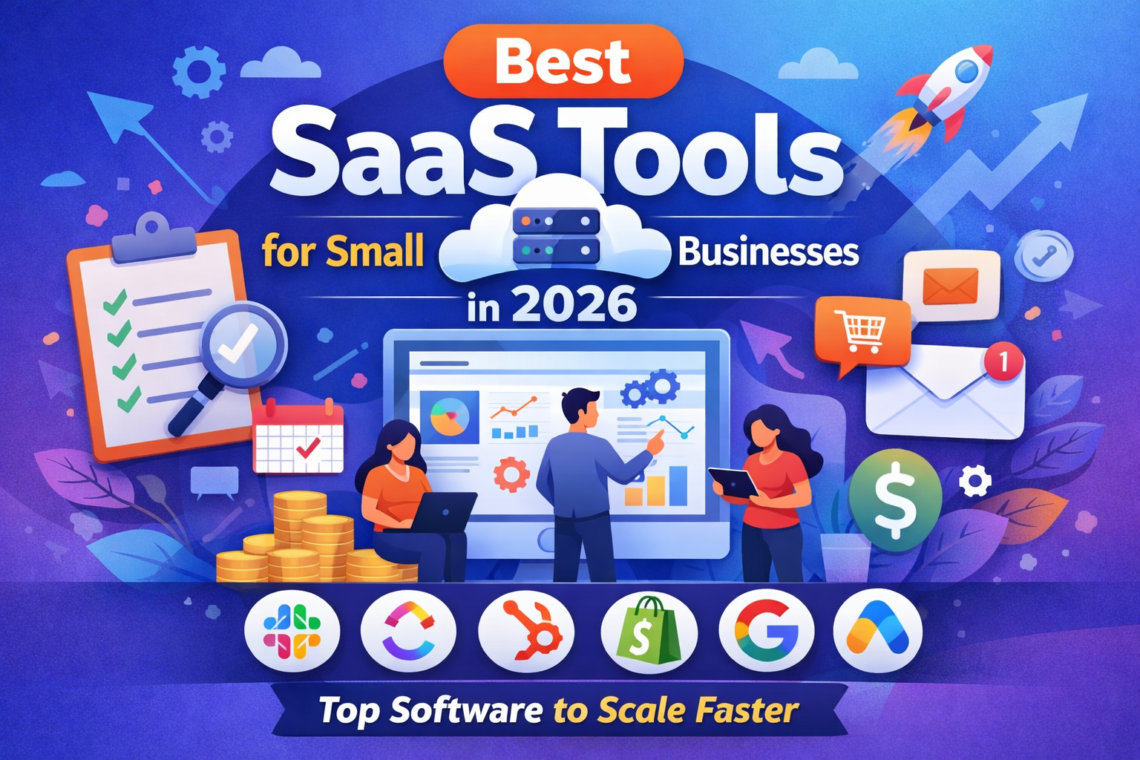
Best SaaS Tools for Small Businesses Software-as-a-Service (SaaS) has completely transformed how modern businesses operate. Instead of purchasing expensive software licenses or maintaining complex infrastructure, companies can now access powerful tools directly through the cloud.
For entrepreneurs and startups, choosing the best SaaS tools for small businesses can dramatically improve productivity, reduce operational costs, and streamline daily workflows. These tools eliminate manual processes and allow teams to collaborate efficiently from anywhere in the world.
From project management and accounting to marketing automation and customer support, SaaS platforms provide scalable, subscription-based solutions tailored for growing businesses.
In this guide, we’ll explore the best SaaS tools for small businesses, including their features, benefits, pricing, and how to choose the right software stack for your company.
Why SaaS Tools Matter for Small Businesses
Small businesses often face challenges such as limited manpower, budget constraints, and inefficient manual workflows. SaaS tools help overcome these barriers by digitizing and automating operations.
Key Benefits
- Cost Efficiency
No need for expensive installations or IT infrastructure.
- Remote Accessibility
Access tools anytime from any device.
- Scalability
Upgrade features as your business grows.
- Automation
Reduce repetitive manual tasks.
- Integration
Connect multiple tools into one workflow.
Using the best SaaS tools for small businesses enables lean management and faster growth.
Top 10 Best SaaS Tools for Small Businesses
1️⃣ ClickUp – All-in-One Project Management
ClickUp combines tasks, documents, CRM, and automation into one centralized workspace. It allows teams to create projects, assign tasks, track deadlines, and monitor performance through customizable dashboards.
Businesses can visualize workflows using boards, lists, calendars, or timelines depending on project needs. ClickUp also includes built-in time tracking and goal management, helping managers measure productivity accurately.
Its automation features reduce repetitive work such as status updates, reminders, and task assignments. This makes ClickUp highly valuable for scaling teams managing multiple clients or campaigns.
Key Features:
- Task tracking
- Time management
- Workflow automation
- Team dashboard
Best For: Agencies & startups managing multiple projects.
2️⃣ Slack – Business Communication Platform
Slack centralizes all business communication into organized channels, eliminating messy email chains. Teams can create separate channels for departments, projects, or clients, ensuring conversations remain structured.
It supports file sharing, voice calls, video meetings, and instant messaging. Slack integrates with thousands of SaaS apps like Google Drive, HubSpot, and ClickUp, making collaboration seamless.
For remote and hybrid teams, Slack improves transparency, speeds up decision-making, and ensures real-time updates across the organization.
Key Features:
- Channels & messaging
- File sharing
- Video calls
- App integrations
- Best For: Remote teams.
3️⃣ HubSpot – CRM & Marketing Automation
HubSpot is a comprehensive SaaS platform designed to manage customer relationships and automate marketing campaigns. It allows businesses to track leads, monitor sales pipelines, and nurture prospects through automated email workflows.
The CRM dashboard provides insights into deal stages, customer interactions, and conversion rates. Businesses can also create landing pages, forms, and marketing funnels within the platform.
HubSpot’s analytics tools help companies optimize campaigns, improve ROI, and make data-driven sales decisions.
Features:
- Lead tracking
- Email automation
- CRM dashboards
- Pipeline management
- Best For: Sales-driven businesses.
4️⃣ Shopify – E-commerce SaaS Platform
Shopify enables small businesses to build and manage online stores without technical expertise. It offers customizable website templates, secure payment gateways, and inventory tracking systems.
Entrepreneurs can sell physical or digital products, manage shipping, and run promotions from a single dashboard. Shopify also integrates with marketing tools, social media platforms, and marketplaces.
Its scalability makes it suitable for both startups and rapidly growing e-commerce brands.
Features:
- Website builder
- Payment integration
- Inventory management
- Marketing tools
- Best For: Product-based businesses.
5️⃣ QuickBooks – Accounting Software
QuickBooks simplifies financial management for small businesses. It automates expense tracking, invoicing, payroll, and tax calculations in one platform.
Business owners can generate financial reports, monitor cash flow, and prepare tax filings with minimal effort. The software also integrates with banking systems for real-time transaction updates.
QuickBooks helps maintain accurate financial records, ensuring compliance and better budgeting decisions.
Features:
- Expense tracking
- Invoicing
- Tax reporting
- Financial analytics
- Best For: Finance management.
6️⃣ Canva – Design SaaS Tool
Canva allows businesses to create professional graphics without hiring designers. It provides thousands of templates for social media posts, ads, presentations, and marketing materials.
Users can drag-and-drop elements, customize brand colors, and collaborate on designs in real time. Canva also includes AI design suggestions and background removal tools.
This makes visual branding affordable and accessible for small teams.
Features:
- Social media graphics
- Ads & presentations
- Templates
- Brand kits
Best For: Marketing teams.
7️⃣ Google Workspace – Collaboration Suite
Google Workspace includes essential productivity tools like Docs, Sheets, Drive, and Meet. It enables real-time document editing, secure cloud storage, and seamless file sharing.
Teams can collaborate on files simultaneously, host virtual meetings, and manage company data centrally. Its cloud infrastructure ensures data security and accessibility.
Google Workspace is often the backbone of daily operations for modern businesses.
Features:
- Cloud storage
- Real-time editing
- File sharing
- Video meetings
Best For: All businesses.
8️⃣ Zapier – Automation SaaS Platform
Zapier connects different SaaS tools and automates workflows without coding. Businesses can create automated “Zaps” that trigger actions between apps.
For example, new leads from a website can automatically be added to a CRM and email list. Zapier saves time by eliminating repetitive manual processes.
It supports thousands of integrations, making it a core automation engine for digital businesses.
Features:
- No-code automation
- Lead syncing
- Email triggers
- App integrations
- Best For: Marketing automation.
9️⃣ Zendesk – Customer Support Software
Zendesk helps businesses manage customer service efficiently through ticketing systems and live chat. It organizes customer queries into structured tickets for faster resolution.
The platform also offers knowledge bases, automation responses, and analytics dashboards. Businesses can track response times, satisfaction scores, and support performance.
Zendesk improves customer experience and retention through professional support systems.
Features:
- Ticketing system
- Live chat
- Knowledge base
- CRM integration
- Best For: Customer experience teams.
🔟 Notion – Knowledge & Workflow Management
Notion combines note-taking, documentation, and project management into one workspace. Businesses use it to create SOPs, internal wikis, and operational dashboards.
It allows teams to collaborate on documents, manage tasks, and store company knowledge centrally. Notion’s flexibility makes it adaptable for multiple departments.
It’s especially useful for startups building structured processes.
Features:
- SOP documentation
- Team wikis
- Project boards
- Databases
Best For: Internal operations.
FAQ
-
What are SaaS tools?
SaaS tools are cloud-based software applications that businesses access through the internet instead of installing them on computers. They usually work on a subscription model and help manage tasks like marketing, accounting, communication, and project management from anywhere.
-
Are SaaS tools affordable?
Yes, most SaaS tools are budget-friendly and designed for startups and small businesses. Many platforms offer free plans or low-cost monthly subscriptions, allowing businesses to start small and upgrade as they grow.
-
Best SaaS for startups?
Some of the best SaaS tools for startups include ClickUp for project management, Notion for documentation, and Slack for team communication. These tools are easy to use, scalable, and ideal for managing growing teams and workflows.
-
Do SaaS tools improve productivity?
Yes, SaaS tools significantly improve productivity by automating repetitive tasks, streamlining communication, and organizing workflows. They help teams save time, reduce manual errors, and focus more on business growth activities.
-
Can businesses run fully on SaaS?
Yes, many modern businesses operate entirely using SaaS platforms. From accounting and marketing to customer support and storage, cloud-based tools can manage almost every business function efficiently.